

Why do we pursue some goals easily, while others we abandon after just a few days? The answer often lies in motivation—but not the superficial, fleeting, or external kind. It’s about deep motivators that align with our values, beliefs, and needs. Only they have the power to build lasting, internal motivation.
1. First Step: Recognize Your Inner Motivation
Before you start building habits, ask yourself: Why do I even want to do this?
It’s not a cliché—this is the first and most important step toward change.
Example? I want to learn Swedish. But if I don’t want to give up after a week, I need to find real reasons that drive me—my personal benefits, not someone else’s expectations or generic templates.
2. Choose the Activity You Want to Build Motivation For
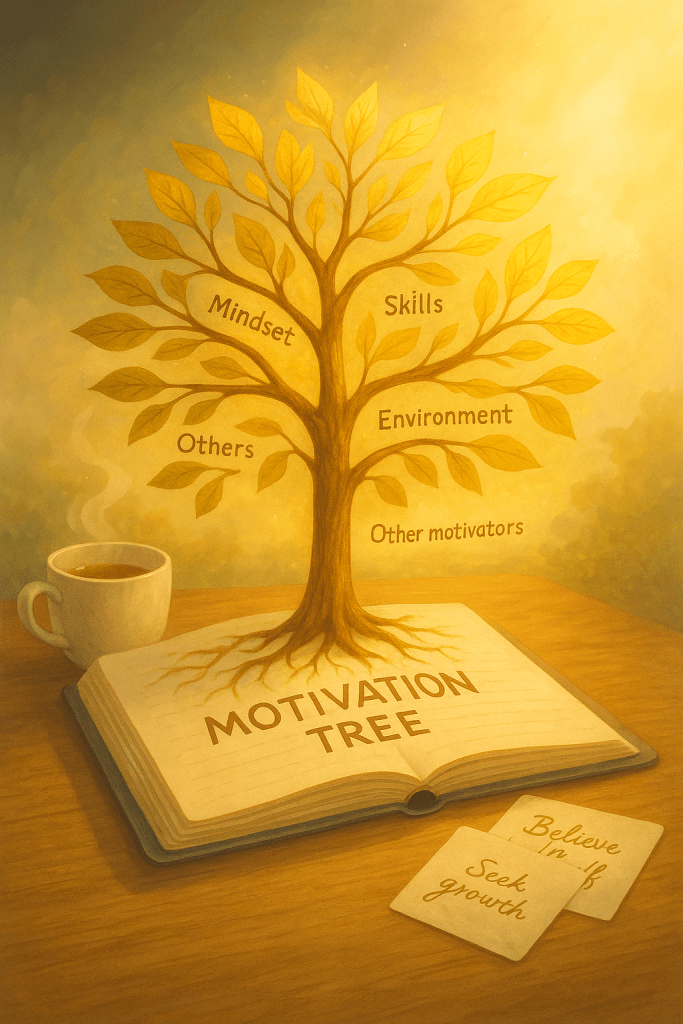
For me, it’s learning Swedish regularly. In an app (or on paper, in a notebook, wherever I want), I create my own “motivation tree” – a place where I will write down step by step what this activity gives me in various areas of my life.
3. The Contexts in the Motivation Tree – Where to Look for Benefits?
The motivation tree is about one question:
“What does this give me?” Why do I really want to do this?
Here are the contexts that help uncover what’s often hidden:
a) Mindset (Psychika)
How will this activity affect my emotions, self-confidence, sense of worth?
👉 For example: greater confidence during conversations, inner calm, sense of effectiveness, pride, independence.
b) Skills & Competencies
What skills will I gain?
👉 Advanced knowledge of Swedish, better communication at work and in personal life, improved memory, focus, and creativity.
c) Environment & System
Impact on my surroundings, workplace, the world.
d) Others
How will this affect the people around me?
👉 I could understand my loved one. I will inspire my loved ones to learn other languages, become a support and authority figure for someone.
e) Spirituality
Does this activity bring me closer to something greater—my mission, purpose, inner fulfillment?
👉 At first, it was hard to see. But then I realized that striving to become the best version of myself, fulfilling my potential, truly moves me.
f) Other Motivators (social, material, prestige-related)
What else will I gain?
👉 Understanding Swedish media, politics and humor, more opportunities to meet interesting people abroad.
4. You Don’t Have to Fill It All – You’re Looking for Clues
This is not about completing every box in your tree.
Sometimes, just a few strongest motivators—those that really move you—are enough.
A motivator can fit more than one context, and that’s totally fine.
It’s not about perfection. It’s about truth—digging deep to uncover what genuinely drives you.
5. Goal: Find the Deep Motivator You Control—Not Others
This motivator—personal, internal, strong—will be the fuel that keeps you going regardless of outside conditions.
It’s not a “stick,” not a “carrot”—it’s your inner why. And it’s always with you.
Your Turn
🔸 Choose one activity you want to build stronger motivation for.
🔸 Fill out the motivation tree based on the steps above—be honest with yourself, do it in silence and calm, just for you. You’re answering why you truly want to start, change, or stop doing something.
🔸 Pay attention to what shows up in different contexts—those might be the clues to your deep motivator. And that’s exactly what you need for this activity to become a part of who you are, not something you do out of obligation or fear of loss.
The goal is to shift from “I must” to:
👉 “I want to.”
👉 “This is who I am.”
👉 “This activity is part of me.” 💛
In the next part, we’ll dive deeper into your motivator(s).
But for now—just start exploring.
Good luck! Marlena 💛💛💛
 Blog Marleny Wach