

Have you ever felt this? You’ve got a goal, even some motivation—but when the moment comes to start, something invisible holds you back. You want to act, but instead, you end up procrastinating, getting distracted, or overthinking.
That’s not laziness—it’s something deeper. It’s called accumulated resistance. It’s that uncomfortable mental weight that builds up right before you take action. A mix of discomfort, excuses, tension, and inner pressure.
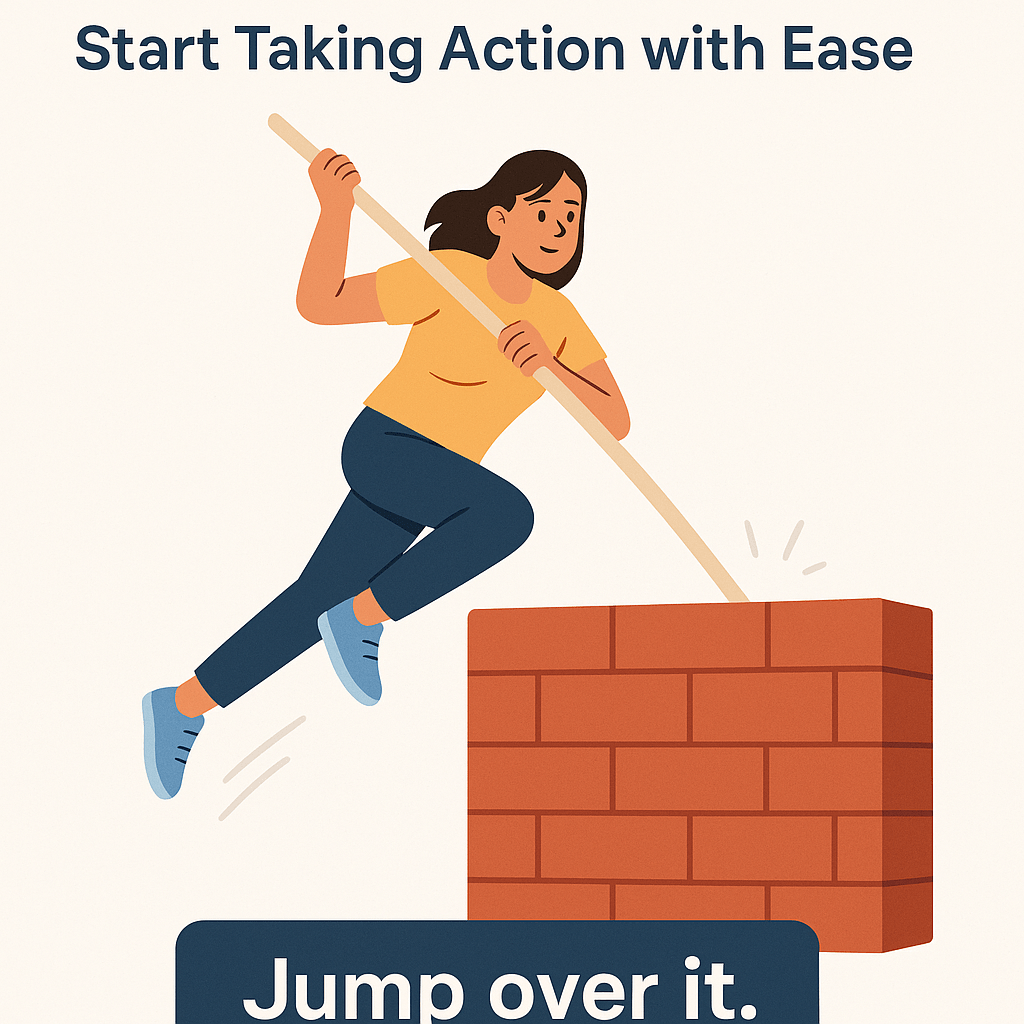
It feels like hitting a brick wall that separates intention from action. 🧱 And if you try to break through it by force, you’ll just drain your mental energy before you’ve even started.
What Builds Up This Wall of Resistance?
- Doubts like “What if I fail?” or “What if I’m not ready?”
- Fear of criticism, failure—or even success
- Low physical or mental energy
- The temptation to do something easier or more enjoyable
- Perfectionism or overwhelm 🙈
Most of the time, this all happens right before you start. But here’s the key: that resistance drops significantly or disappears altogether once you begin. ✅
So What Can You Do?
Don’t fight it. Don’t waste your energy smashing through that wall. Instead, jump over it. 🦘
Imagine using a long pole to vault over the wall—quickly and effortlessly. That pole is called the starting block. 🏁
What’s a Starting Block?
It’s a tiny, specific, repeatable action that shifts you into motion. It creates tunnel focus—you stop thinking about the whole task and concentrate on one small, frictionless move. 🎯
Examples:
- 🧽 Cleaning → putting on rubber gloves
- 💻 Laptop work → closing irrelevant tabs and opening the ones you need
- 📚 Studying → opening your book to the right page
- 🏋️♀️ Working out → putting on gym clothes
But Motivation Still Isn’t Action… 🔗 So Let’s Add the linked techniques
Even if you feel ready and have your starting block defined, you still need to make a micro-decision that turns motivation into motion. That’s where the linking technique comes in.
There are two simple versions of this technique:
1. The 5-Second Now Formula ⏱️
Use this when you can start right now.
Say to yourself, either out loud or in your mind:
“I’m going to [insert your starting block] right now.”
Then start counting backward:
“5… 4… 3… 2… 1…”
👉 You must physically begin during the countdown. Get up. Move. Do it.
If you don’t, you’ll feel a small sense of discomfort—because you just broke your word to yourself. That’s the emotional cue that builds self-discipline.
📌 Example:
You’re sitting on the couch watching Netflix, but your starting block is “sit at the desk and open my book.”
Say: “I’m going to sit at the desk and open my book. 5… 4… 3…” — start moving.
2. The Future Link Formula 🔮
Use this when you can’t start right now, but you know when you will.
Say:
“As soon as I [trigger event], I’ll [starting block].”
📌 Example:
“As soon as I get home from work, I’ll sit at my desk and open my book.”
No countdown here—just a clear mental contract for a future trigger. 🎯
Why Does This Work So Well? ⚙️
Because it links intention to action in a specific, timed, and non-negotiable way.
You’re not waiting for motivation—you’re giving your brain clear instructions and a deadline.
Used alone, it helps.
Used together with the starting block, it’s magic. ✨
In Summary 📝
- Resistance is real—but it drops after you start.
- Use a starting block to trick your brain into effortless tunnel focus.
- Use the linking technique to go from “I want to” to “I’m doing it.”
- Combine both to leap over resistance like a pro.
You don’t need to force your way through the wall.
Just jump over it.
 Blog Marleny Wach