

On 12 and 13 November 2026, a major disruption affected Microsoft 365 services around the world, including Outlook, Teams and other widely used workplace tools.
For many employees, the immediate inconvenience was familiar: inaccessible email, delayed messages and meetings that could not proceed as planned. For organisations, however, the consequences went considerably further.
Reuters reported that businesses resorted to telephone calls, fax machines and alternative communication methods to maintain essential operations. Financial institutions activated contingency arrangements, while some public services experienced disruption.
Microsoft explained that the incident resulted from a technical problem associated with an earlier network-capacity upgrade, rather than a cyberattack or AI-related activity. The company apologised, reported broad recovery and committed to publishing a post-incident review. The episode raises an important question that applies to almost every organisation using cloud services.
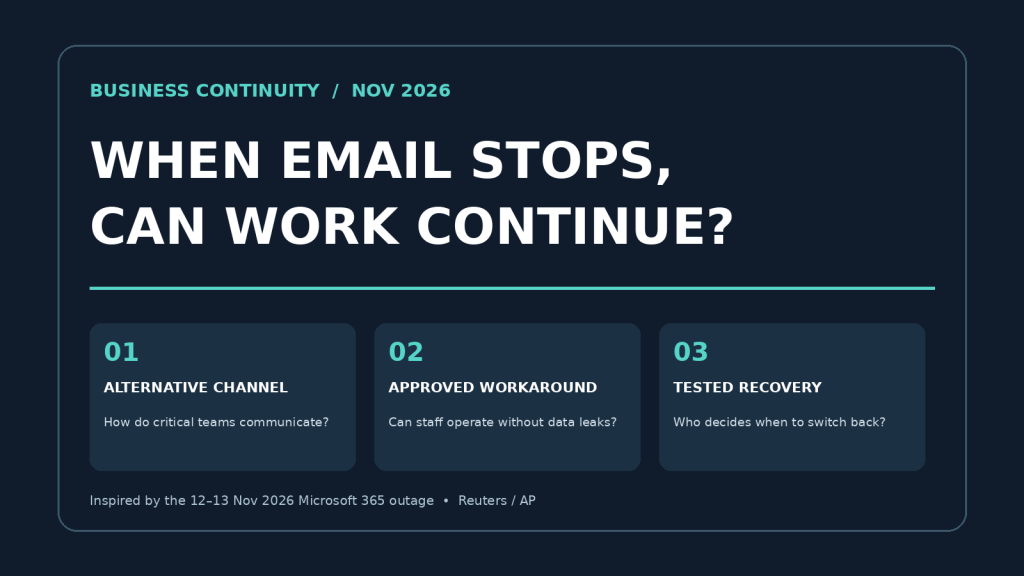
Business Continuity Is More Than Having a Backup
A business continuity plan may identify alternative systems, emergency contacts and recovery responsibilities. But the real challenge begins when those arrangements must operate under pressure.
Imagine a financial services company whose employees cannot access corporate email. A client needs an urgent transaction confirmed, but the normal approval workflow is unavailable.
An employee might reasonably consider using a personal messaging application to resolve the problem. That decision could restore communication, but it could also create confidentiality, information-security and recordkeeping risks.
The difficulty is not necessarily the absence of an alternative tool. It is whether the organisation has approved a safe way to use it.
The Legal Dimension of an Operational Failure
European regulation increasingly treats operational resilience as a governance responsibility. Under NIS2, entities within scope must implement appropriate cybersecurity risk-management measures, including business continuity, backup management, disaster recovery and crisis management.
For financial entities subject to DORA, ICT business continuity and recovery arrangements are also central requirements.
These frameworks do not mean that every interruption automatically constitutes a regulatory breach or a reportable cybersecurity incident. A technical outage, a cyberattack and a personal data breach are legally distinct situations. Their reporting consequences depend on the applicable framework and the facts. Nevertheless, organisations must be able to demonstrate that their resilience arrangements are appropriate to their risks and obligations.
The Contract Cannot Replace the Contingency Plan
Cloud contracts frequently contain availability commitments, service credits and incident-management provisions. Those provisions matter, but financial compensation after an outage does not necessarily restore a missed deadline, an interrupted service or an important client relationship.
This is why contractual protections and operational planning must work together. Organisations should understand which processes depend on a particular provider, what happens if multiple services become unavailable simultaneously, and whether alternative arrangements have actually been tested.
A recovery procedure that exists only in a document may offer little protection during a real disruption.
The Question Worth Asking Before the Next Outage
The most useful lesson from this week’s incident is not that cloud services are inherently unreliable. They provide enormous operational benefits, and even sophisticated infrastructure can experience failures. The lesson is that dependence should be understood before it becomes a crisis.
A practical exercise is to identify one essential business process and imagine that email, shared documents and normal authentication methods are unavailable for an entire working day. Who has authority to activate the alternative procedure? How will staff communicate securely? Which obligations must still be met?
Business continuity is not simply the ability to recover technology. It is the ability to continue making responsible decisions while that technology is unavailable.
#BusinessContinuity #CyberResilience #NIS2 #TechnologyLaw

