
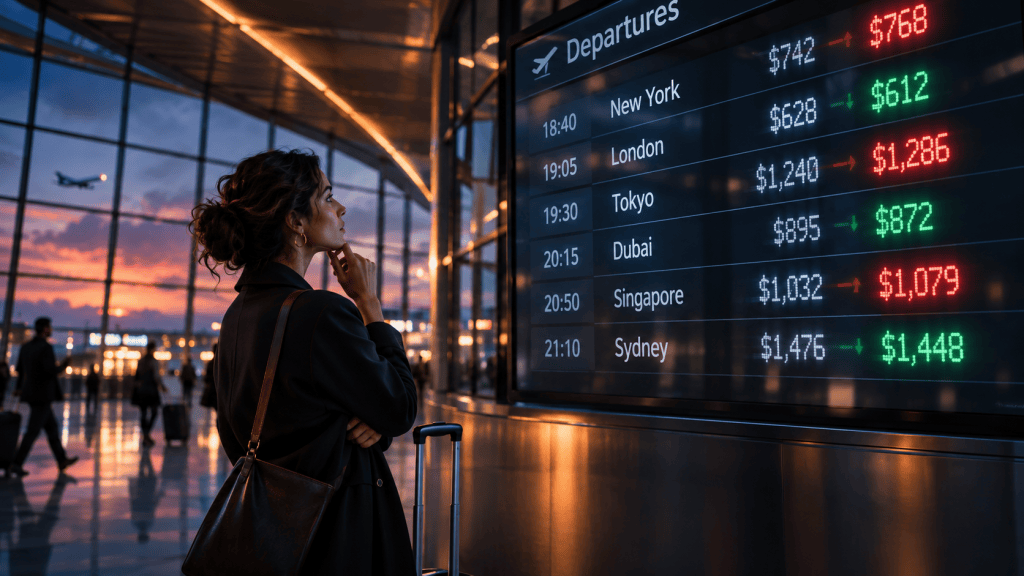
You search for a flight on Monday. On Tuesday, the price has increased. You clear your cookies, open a private browser window and check again. The price remains the same. It is tempting to conclude that the airline knows you are interested and is using that information to charge you more.
But a recent investigation by the Netherlands Authority for Consumers and Markets (ACM) challenges this familiar assumption. The regulator examined computer-driven pricing in the aviation sector and found something more interesting than individual tracking: substantial price differences can arise without an airline tailoring the fare to a particular customer.

Thirty-Five Prices for the Same Seat
According to the ACM’s draft findings, a seat on the same flight is offered at an average of 30 to 35 different prices during its selling period. One in three tickets is sold at a price at least 40% above the average ticket price for that flight.
These differences largely reflect dynamic pricing. Airlines adjust fares as demand, available capacity, competitor prices and departure dates change. The investigation also found that earlier searches and the device used did not influence the ticket prices examined.
This matters because consumers often confuse two fundamentally different practices. Dynamic pricing changes the price according to market conditions. Personalised pricing uses information about an individual customer to determine the price offered to that person. Both can involve algorithms. But they raise different questions about transparency, privacy and fairness.
The Problem Is Not Necessarily Discrimination
Dynamic pricing is not inherently unlawful or unfair. Airlines have limited capacity and must manage seats that become worthless once an aircraft departs. Changing prices can improve occupancy and allow some passengers to travel more cheaply.
The difficulty arises when consumers cannot understand why prices change or which factors influence them. ACM’s research suggests that this uncertainty creates additional search costs: people spend time repeatedly checking fares, experimenting with devices and worrying about whether they should book immediately.
For someone with flexible travel dates, this may be inconvenient. For someone travelling urgently or on a limited budget, the consequences can be more significant.

What Does EU Consumer Law Actually Require?
Existing EU consumer law distinguishes personalised pricing from ordinary dynamic pricing. Under the Consumer Rights Directive, as amended by Directive (EU) 2019/2161, traders must inform consumers when a price has been personalised on the basis of automated decision-making.
That does not mean every algorithmic price adjustment must be individually explained. The ACM argues that this leaves an important transparency gap. Consumers may know the price they are being charged without understanding what influences it.
Its consultation on computer-driven pricing closed on 9 November 2026. The regulator expects to publish its final report by the end of the year and plans further discussion in early 2027. These are research findings and recommendations, not a new prohibition on dynamic pricing.
Transparency Without Revealing Every Algorithm
There is a legitimate commercial argument against requiring businesses to disclose every detail of their pricing models. Such information may be competitively sensitive and could make pricing systems easier to manipulate.
But meaningful transparency does not necessarily require publishing source code or proprietary formulas. A business could explain whether prices respond to demand, availability, booking time or individual customer characteristics. Equally important, it could clarify which factors do not influence the price.
The ACM’s investigation offers a useful lesson for digital businesses: customers do not necessarily need to understand the mathematics behind every price. They need enough reliable information to make decisions without unnecessary uncertainty.
A changing price is not automatically an unfair price. But a pricing system that nobody can meaningfully explain creates a problem of its own: distrust.
#DynamicPricing #ConsumerProtection #DigitalRegulation #AlgorithmicTransparency