

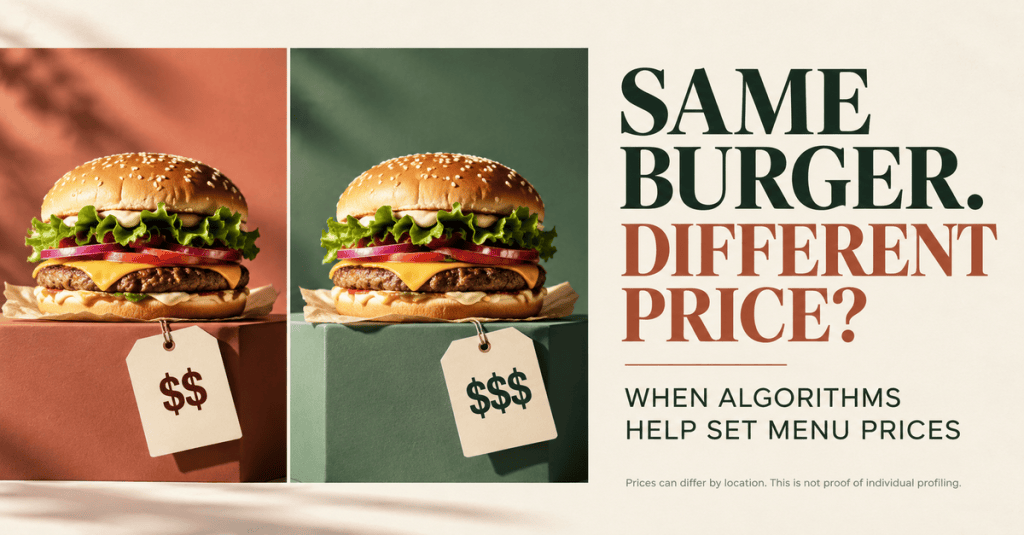
Imagine ordering a burger and discovering that another restaurant just two miles away sells exactly the same product for 21% less. Now imagine that an algorithm helped determine what customers in each location might be willing to pay.
This is no longer just a theoretical debate about the future of pricing.
McDonald’s and the AI Pricing Debate
In an investigation published on 29 September 2026 and updated on 7 October, Reuters revealed details of how McDonald’s uses machine-learning technology to recommend menu prices across thousands of restaurants.
The system analyses transaction data, local demand, competitors’ prices and estimated customer willingness to pay.
Reuters found that two company-operated McDonald’s restaurants in Fresno, California, approximately two miles apart, were selling a Big Mac for $5.69 and $6.89 respectively. However, Reuters could not establish whether the pricing system caused that difference.
McDonald’s maintains that its technology provides restaurant-specific recommendations rather than automatically setting prices, and that franchisees retain final pricing authority.
This is important: the investigation does not establish that McDonald’s charges individual customers different prices based on their personal profiles.
What Happens When Prices Become Personal?
A separate and broader practice, sometimes described as surveillance pricing, raises an even more uncomfortable question.
In January 2025, the US Federal Trade Commission reported that some pricing intermediaries use information such as location, browsing history and shopping behaviour to help determine individualised prices.
That means two people shopping online could potentially be offered different prices or discounts based on what a company knows about them.
New York has already responded. Since 10 November 2025, its Algorithmic Pricing Disclosure Act has required qualifying businesses to inform consumers when prices are set using algorithms and their personal data.
A Question of Fairness
There is nothing inherently wrong with a restaurant charging different prices in different locations. Rent, wages, demand and operating costs vary.
But should a business be allowed to use personal information to estimate the maximum amount a particular customer is willing to pay?
Personalised discounts can benefit consumers. Personalised price increases, especially when customers have no idea they are being profiled, raise very different questions.
Technology can make pricing more efficient. Whether it also makes pricing fairer depends on the rules companies choose to follow.
Would you accept paying more for the same product simply because an algorithm predicted you were willing to spend more?
#ConsumerRights #AlgorithmicPricing #DigitalFairness #Privacy

