
How to Jump Over the Wall of Resistance and Start Taking Action with Ease 🧱

Have you ever felt this? You’ve got a goal, even some motivation—but when the moment comes to start, something invisible holds you back. You want to act, but instead, you end up procrastinating, getting distracted, or overthinking.

That’s not laziness—it’s something deeper. It’s called accumulated resistance. It’s that uncomfortable mental weight that builds up right before you take action. A mix of discomfort, excuses, tension, and inner pressure.

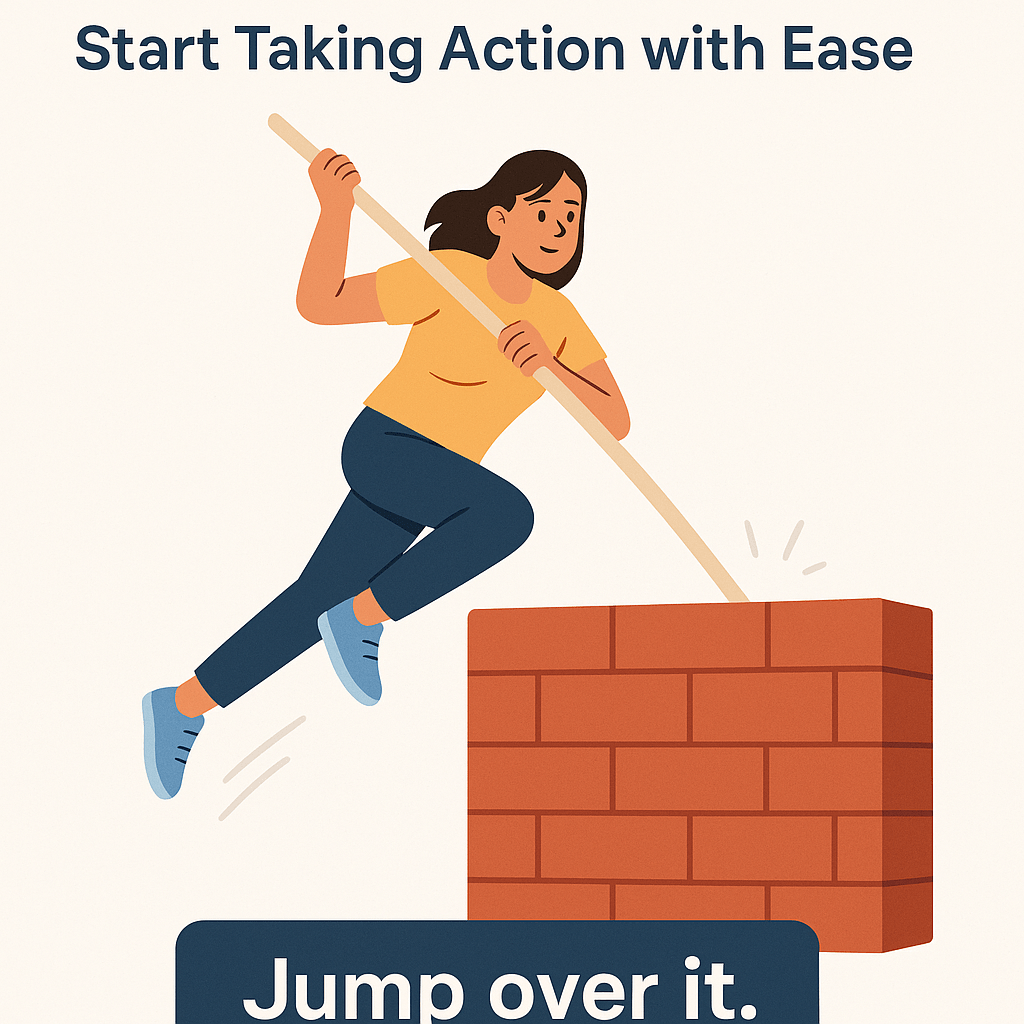
It feels like hitting a brick wall that separates intention from action. 🧱 And if you try to break through it by force, you’ll just drain your mental energy before you’ve even started.
What Builds Up This Wall of Resistance?

  • Doubts like “What if I fail?” or “What if I’m not ready?”
  • Fear of criticism, failure—or even success
  • Low physical or mental energy
  • The temptation to do something easier or more enjoyable
  • Perfectionism or overwhelm 🙈

Most of the time, this all happens right before you start. But here’s the key: that resistance drops significantly or disappears altogether once you begin.

So What Can You Do?

Don’t fight it. Don’t waste your energy smashing through that wall. Instead, jump over it. 🦘

Imagine using a long pole to vault over the wall—quickly and effortlessly. That pole is called the starting block. 🏁

What’s a Starting Block?

It’s a tiny, specific, repeatable action that shifts you into motion. It creates tunnel focus—you stop thinking about the whole task and concentrate on one small, frictionless move. 🎯

Examples:

  • 🧽 Cleaning → putting on rubber gloves
  • 💻 Laptop work → closing irrelevant tabs and opening the ones you need
  • 📚 Studying → opening your book to the right page
  • 🏋️‍♀️ Working out → putting on gym clothes

But Motivation Still Isn’t Action… 🔗 So Let’s Add the linked techniques

Even if you feel ready and have your starting block defined, you still need to make a micro-decision that turns motivation into motion. That’s where the linking technique comes in.

There are two simple versions of this technique:

1. The 5-Second Now Formula ⏱️

Use this when you can start right now.

Say to yourself, either out loud or in your mind:

“I’m going to [insert your starting block] right now.”

Then start counting backward:

“5… 4… 3… 2… 1…”

👉 You must physically begin during the countdown. Get up. Move. Do it.
If you don’t, you’ll feel a small sense of discomfort—because you just broke your word to yourself. That’s the emotional cue that builds self-discipline.

📌 Example:
You’re sitting on the couch watching Netflix, but your starting block is “sit at the desk and open my book.”
Say: “I’m going to sit at the desk and open my book. 5… 4… 3…” — start moving.

2. The Future Link Formula 🔮

Use this when you can’t start right now, but you know when you will.

Say:

“As soon as I [trigger event], I’ll [starting block].”

📌 Example:
“As soon as I get home from work, I’ll sit at my desk and open my book.”

No countdown here—just a clear mental contract for a future trigger. 🎯

Why Does This Work So Well? ⚙️

Because it links intention to action in a specific, timed, and non-negotiable way.
You’re not waiting for motivation—you’re giving your brain clear instructions and a deadline.

Used alone, it helps.
Used together with the starting block, it’s magic. ✨

In Summary 📝

  1. Resistance is real—but it drops after you start.
  2. Use a starting block to trick your brain into effortless tunnel focus.
  3. Use the linking technique to go from “I want to” to “I’m doing it.”
  4. Combine both to leap over resistance like a pro.

You don’t need to force your way through the wall.
Just jump over it.
How to Find Your Deep Motivator? Step by Step with the Motivation Tree

Why do we pursue some goals easily, while others we abandon after just a few days? The answer often lies in motivation—but not the superficial, fleeting, or external kind. It’s about deep motivators that align with our values, beliefs, and needs. Only they have the power to build lasting, internal motivation.

1. First Step: Recognize Your Inner Motivation

Before you start building habits, ask yourself: Why do I even want to do this?
It’s not a cliché—this is the first and most important step toward change.
Example? I want to learn Swedish. But if I don’t want to give up after a week, I need to find real reasons that drive me—my personal benefits, not someone else’s expectations or generic templates.

2. Choose the Activity You Want to Build Motivation For

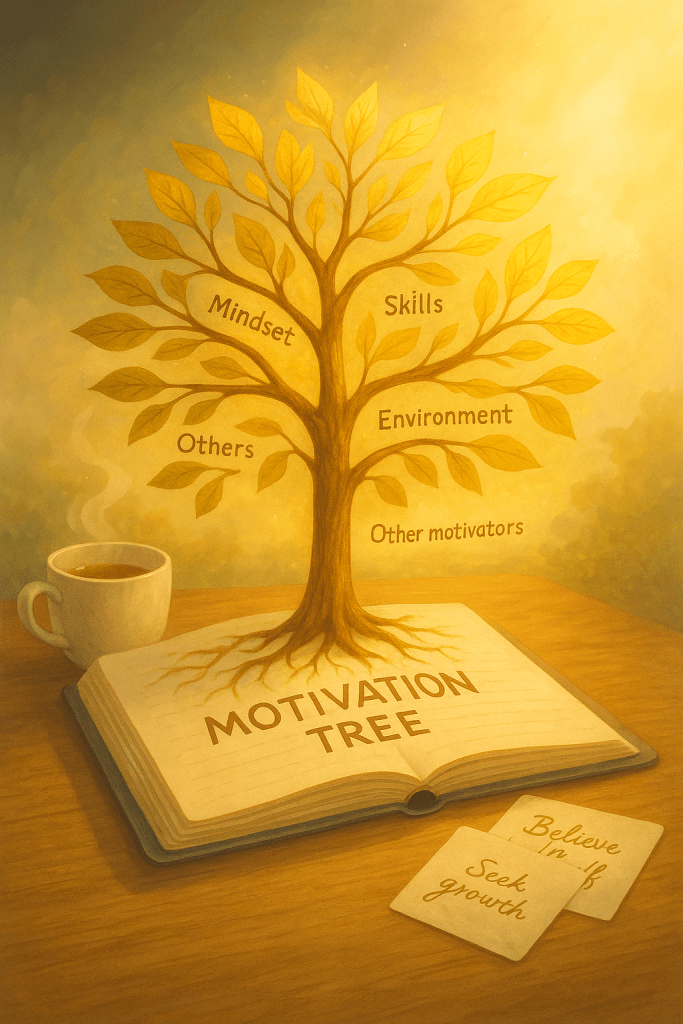
For me, it’s learning Swedish regularly. In an app (or on paper, in a notebook, wherever I want), I create my own “motivation tree” – a place where I will write down step by step what this activity gives me in various areas of my life.

3. The Contexts in the Motivation Tree – Where to Look for Benefits?

The motivation tree is about one question:
“What does this give me?” Why do I really want to do this?
Here are the contexts that help uncover what’s often hidden:

a) Mindset (Psychika)

How will this activity affect my emotions, self-confidence, sense of worth?
👉 For example: greater confidence during conversations, inner calm, sense of effectiveness, pride, independence.

b) Skills & Competencies

What skills will I gain?
👉 Advanced knowledge of Swedish, better communication at work and in personal life, improved memory, focus, and creativity.

c) Environment & System

Impact on my surroundings, workplace, the world.
d) Others

How will this affect the people around me?
👉 I could understand my loved one. I will inspire my loved ones to learn other languages, become a support and authority figure for someone.

e) Spirituality

Does this activity bring me closer to something greater—my mission, purpose, inner fulfillment?
👉 At first, it was hard to see. But then I realized that striving to become the best version of myself, fulfilling my potential, truly moves me.

f) Other Motivators (social, material, prestige-related)

What else will I gain?
👉 Understanding Swedish media, politics and humor, more opportunities to meet interesting people abroad.

4. You Don’t Have to Fill It All – You’re Looking for Clues

This is not about completing every box in your tree.
Sometimes, just a few strongest motivators—those that really move you—are enough.
A motivator can fit more than one context, and that’s totally fine.
It’s not about perfection. It’s about truth—digging deep to uncover what genuinely drives you.

5. Goal: Find the Deep Motivator You Control—Not Others

This motivator—personal, internal, strong—will be the fuel that keeps you going regardless of outside conditions.
It’s not a “stick,” not a “carrot”—it’s your inner why. And it’s always with you.

Your Turn

🔸 Choose one activity you want to build stronger motivation for.
🔸 Fill out the motivation tree based on the steps above—be honest with yourself, do it in silence and calm, just for you. You’re answering why you truly want to start, change, or stop doing something.
🔸 Pay attention to what shows up in different contexts—those might be the clues to your deep motivator. And that’s exactly what you need for this activity to become a part of who you are, not something you do out of obligation or fear of loss.

The goal is to shift from “I must” to:
👉 “I want to.”
👉 “This is who I am.”
👉 “This activity is part of me.” 💛

In the next part, we’ll dive deeper into your motivator(s).
But for now—just start exploring.

Good luck! Marlena 💛💛💛