

Introductory remarks
From the perspective of a Swedish investor planning to establish operations in Poland or to invest in a Polish company, one of the key areas requiring analysis already at the structuring stage is the corporate governance model. This is not merely an organisational or formal matter. The chosen structure determines not only how decisions are made, but also the extent of shareholder influence, the relationship between shareholders and management, the level of autonomy granted to local executives, the way supervision over the company is exercised, and the scope of liability of individuals serving on corporate bodies.
In practice, differences in corporate governance are among the most frequent sources of misunderstanding in Polish-Swedish business relationships. This results from the fact that both systems use similar terminology – board, CEO, management, supervisory body – while assigning different legal meaning, different powers and different responsibilities to those bodies.
Management board in Poland as a corporate body
The Polish limited liability company is based on the continental European concept of separation between shareholders and the corporate bodies of the company. Under Article 201 §1 of the Polish Commercial Companies Code, the management board manages the affairs of the company and represents the company.
This principle is fundamental in Polish corporate law.
The management board represents the company itself as a separate legal entity. It does not represent the shareholders. It does not act as agent of the investor or as an extension of shareholder instructions. Once appointed, a member of the management board becomes part of the statutory governing body of the company and is legally required to act in the best interests of the company itself.
This distinction is often particularly important for foreign investors. Even where one shareholder holds all shares in the company, the management board does not legally represent that shareholder. It represents the company.
For Swedish investors, this often comes as a surprise, as in the Swedish governance structure shareholder influence is usually exercised more directly through the board.
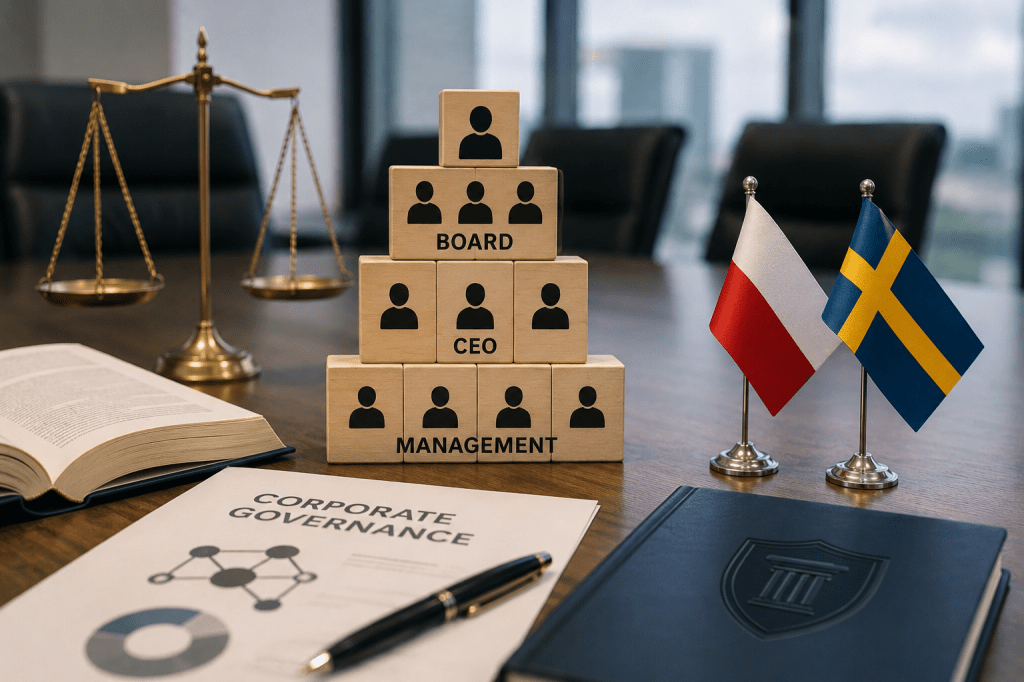
The Swedish model: shareholders – board – CEO
In Sweden the chain of authority is structured differently. Shareholders appoint the board of directors at the general meeting. The board is responsible for the organisation of the company, strategic direction, governance and overall supervision of the business.
The board then appoints the CEO (verkställande direktör / VD). The CEO is therefore not appointed directly by shareholders, but by the board, and manages the day-to-day operations of the company within the framework determined by the board.
In practical terms, the structure can be summarised as follows: shareholders appoint the board, the board appoints the CEO, and the CEO manages the daily operations.
As a result, the Swedish board remains the central instrument through which shareholder influence is exercised and stays closely connected to strategy and leadership of the company.
Polish supervisory board versus Swedish board – two different governance models
A particularly important distinction for Swedish investors is that the Polish supervisory board (rada nadzorcza) is not the equivalent of a Swedish board of directors.
Although the terminology may suggest a similarity, these are structurally and functionally different corporate bodies.
In Poland, the supervisory board is a body of supervision and control. Its role is to supervise the company’s activities and oversee the management board. It may review company documents, request information, assess management activities, examine financial statements and exercise supervisory powers resulting from law or the articles of association.
However, it does not manage the affairs of the company. It does not conduct day-to-day operations and, as a rule, does not issue operational instructions to the management board concerning the running of the business.
This differs fundamentally from the Swedish board. The Swedish board combines strategic, organisational and supervisory functions. It appoints the CEO, determines the framework within which the CEO operates and remains much closer to the business and strategic decision-making process.
For a Swedish investor this distinction is highly relevant in practice. Assuming that a Polish supervisory board functions in the same way as a Swedish board may lead to an incorrect understanding of where actual control over the company is exercised.
Articles of association and the exercise of shareholder influence
In Poland, actual shareholder influence is exercised primarily through corporate rights and through the articles of association.
Members of the management board are appointed and removed by shareholders’ resolution unless the articles of association provide otherwise. This reservation is particularly important from an investor’s perspective.
In practice, the articles of association are the key legal instrument shaping shareholder relations and the real governance framework of the company. They may regulate appointment and dismissal rights, individual nomination rights, veto rights, reserved matters requiring shareholder or supervisory board approval, reporting obligations, transfer restrictions and broader governance mechanisms.
As a result, the real level of investor control in Poland often depends not only on the percentage of shares held but on the quality and precision of the constitutional corporate documentation.
Entering the Polish market – S24 incorporation, shelf companies and the role of the notary
Polish law provides considerable flexibility when entering the market. A limited liability company may be incorporated online through the S24 electronic registration system with a minimum share capital of PLN 5,000. If the filing is properly prepared, registration may be completed within a very short timeframe.
At the same time, in transactional practice it is also common to acquire so-called shelf companies – entities already incorporated and prepared for acquisition. This solution is typically used where timing is critical, where certain corporate history is required, or where a company must be immediately ready for closing or restructuring.
Where such business reasons do not exist, a newly incorporated company is often the more practical solution.
Regardless of the chosen route, adapting the corporate documentation after incorporation or acquisition is usually essential, particularly the articles of association, as standard template documentation rarely reflects the governance needs of a specific investor structure.
The role of the notary also remains significant in Poland, particularly with respect to amendments to the articles of association, share transfers and many ownership or restructuring transactions.
Liability of management board members in Poland
Liability of management board members remains one of the most important practical issues for investors.
As a general rule, the company itself is liable for its obligations as a separate legal entity. However, Polish law also provides situations in which liability may extend personally to members of the management board.
Particularly important is Article 299 of the Polish Commercial Companies Code. If enforcement against the company proves ineffective, members of the management board may become jointly and severally liable for the company’s obligations.
Although this does not automatically mean personal liability in every case, it creates real financial exposure for management board members and remains one of the most important legal risk factors connected with serving on a Polish management board.
In litigation practice it is also common for claims to be brought not only against the company itself but also – in parallel or alternatively – against members of the management board. In practice, the full management board is often included in disputes together with the company already at an early procedural stage.
Delegation of responsibilities and internal allocation of authority
Given the scope of liability, internal governance organisation becomes particularly important.
In practice, companies frequently adopt management board resolutions, internal regulations or a matrix of authority assigning responsibility for specific business areas to individual board members or functional directors responsible for finance, sales, procurement, compliance, operations or HR.
Such allocation does not automatically remove statutory liability. However, it has major practical value. It helps evidence the actual division of responsibilities within the organisation, supports internal governance and supervision and may also be relevant in litigation.
Where a board member can demonstrate that a particular area was assigned to another responsible person, that they had no decision-making authority in that area and no actual influence over the relevant conduct, this may be taken into account when assessing liability.
A properly documented allocation of authority therefore remains one of the key practical tools for managing governance and reducing management risk in Poland.
Discharge from liability and annual approval of actions of corporate bodies
Another important governance comparison concerns the annual approval of the actions of corporate bodies.
In Sweden, shareholders at the general meeting resolve on discharge from liability (ansvarsfrihet) for members of the board and the CEO. This serves as an important shareholder governance mechanism through which shareholders formally assess performance of those responsible for strategic management and operational leadership.
In Poland, the equivalent mechanism is absolutorium.
At the annual shareholders’ meeting, shareholders adopt resolutions granting discharge to members of the management board and – where established – members of the supervisory board in respect of performance of their duties during the previous financial year.
This reflects the dual structure of the Polish corporate governance model, where shareholders separately assess the performance of the management board as the body managing and representing the company, and the supervisory board as the body supervising the company’s activities.
Liability of the board and CEO in Sweden
In Sweden liability is structured differently because the allocation of functions is different.
The board remains responsible for the organisation of the company, strategic direction and supervision. The CEO remains responsible for day-to-day operational management within the framework established by the board.
Although certain responsibilities may be delegated, the board retains overall responsibility for supervision and governance of the company.
Liability is therefore assessed in light of board instructions, CEO instructions, delegation principles, decision-making processes and internal reporting lines between the board and the CEO.
Employee representation
A further structural difference concerns employee representation.
In larger Swedish companies employees may have representatives on the board. In practice, however, such representatives usually remain in the minority compared with shareholder-appointed members and generally do not determine the outcome of board decisions.
In a Polish limited liability company, employees do not typically participate either in the management board or the supervisory board. Employee interests are generally represented outside the corporate body structure, primarily through labour law mechanisms and trade unions.
Practical conclusions for Swedish investors
For Swedish investors, entering Poland requires more than choosing the appropriate legal vehicle. It requires careful and deliberate governance design.
The key practical point is understanding that the Polish management board is not the equivalent of the Swedish CEO, the Polish supervisory board is not the equivalent of the Swedish board of directors, and actual shareholder influence in Poland is exercised primarily through well-drafted constitutional documentation and carefully structured governance arrangements.
In practice, it is the articles of association, appointment mechanisms, allocation of powers, reporting framework and internal division of responsibilities that determine investor protection, effective shareholder control and long-term stability of operations in Poland.


