Your Past Influences You — But Doesn’t Define Your Future

You might feel that your upbringing, early environment, or childhood experiences make it harder to change today. And sure, they do have an effect—but do they free you from responsibility now? Do they mean you’re destined to stay stuck?

Absolutely not.

1. The Difference Between “Influence” and Determination

Early life events shape our personality, behavior, and mental health—but they’re not destiny. Studies show adverse childhood experiences (ACEs) can increase adult anxiety, depression, or chronic health issues—but they don’t make these outcomes inevitable.

Likewise, childhood personality traits influence adult self-regulation and behavior patterns, but mechanisms like social learning and adaptive change remain powerful PMC. Early influences are significant—the “long arm” of childhood can stretch into adulthood—but it also interacts with later experiences and our choices.

2. Upbringing Doesn’t Equal Permanent Damage

History doesn’t seal your future. Even if your childhood presented mental health struggles or toxic patterns, it didn’t irreversibly “wire” you in a way that makes change impossible.

You can absolutely shape new behaviors, regulate emotions better, and refocus your habits—and your past can be an asset, not a hindrance.

3. Going Beyond Blame: Responsibility Now

It’s tempting to say, “I can’t change because I was raised like that.” That thought, however, is just another mental shortcut—a self-serving bias that protects the ego but stops progress.

Your context may make things harder, but it doesn’t give you permission to avoid responsibility. You can accept the hand you were dealt—and then intentionally play it differently.

4. How to Understand and Use Your Personal Background

  • Awareness is Strength: Knowing that you were parentified or emotionally burdened (where you took on adult roles too early) can explain current patterns—but it also highlights blind spots you can address.
  • Leverage Self-Efficacy: Confidence grows from successes. Even small wins matter—Bandura’s research shows belief in your ability builds through action.
  • Use Systems, Not Willpower Alone: If habits feel hard, set up supports: reminders, accountability, implementation intentions (“when X, I do Y”).

5. Habits Are Liberators, Not Prisoners

Think of a bicycle: having one doesn’t prevent walking. It augments your mobility.

Similarly, habits free you. They automate small actions—like brushing your teeth or tying your shoe—so you can focus your energy on what matters. Mental habits work the same way: they save willpower for bigger decisions.

Even if you create new routines for growth—journaling, reading, planning—they’re never stronger than your basic habits. You can stop any habit anytime. That means your past habits don’t enslave you—you are free to choose again.

6. Why Discipline Isn’t a Threat—but a Tool

Gaining self-discipline gives you options. Just as cycling doesn’t kill walking, discipline doesn’t override flexibility. Whether your goal is productivity, creativity, wellness, or connection—you use self-control to serve what matters to you. The choice is yours.

7. Your Past Can Be Leverage—Not Excuse

Use your self-awareness proactively: if you notice you revert to old patterns under stress, plan ahead. Maybe that means extra self-care, support routines, or break plans.

Awareness is half the battle. The other half is deciding: “Now I build something different.”

8. Why Waiting Is the Biggest Loss

Every day lived without intentional growth—even amid challenges or barriers—is a day of lost potential:

  • Less fun, spontaneity, or depth.
  • Missed moments with loved ones.
  • Opportunities that quietly slip away.
  • Unused talents left for the future.

Time doesn’t rewind. Any delay in growth—even a day—counts.

9. You’ve Started Already—Now Go Further

You’re here, reading this. You’ve shown the awareness and capacity to take responsibility. You have at least 10 minutes a day to exercise this power.

Imagine: a minute to register your intentions, 10 minutes to reflect, plan, or read. That is enough. From there, your self-discipline and organization will grow—and the time you need will follow.

Should You Create One or Multiple Balancing Statements for a Belief?

If you’re working to challenge a limiting belief, you might wonder:
Should I create just one balancing statement, or several — each with different facts and counterarguments?

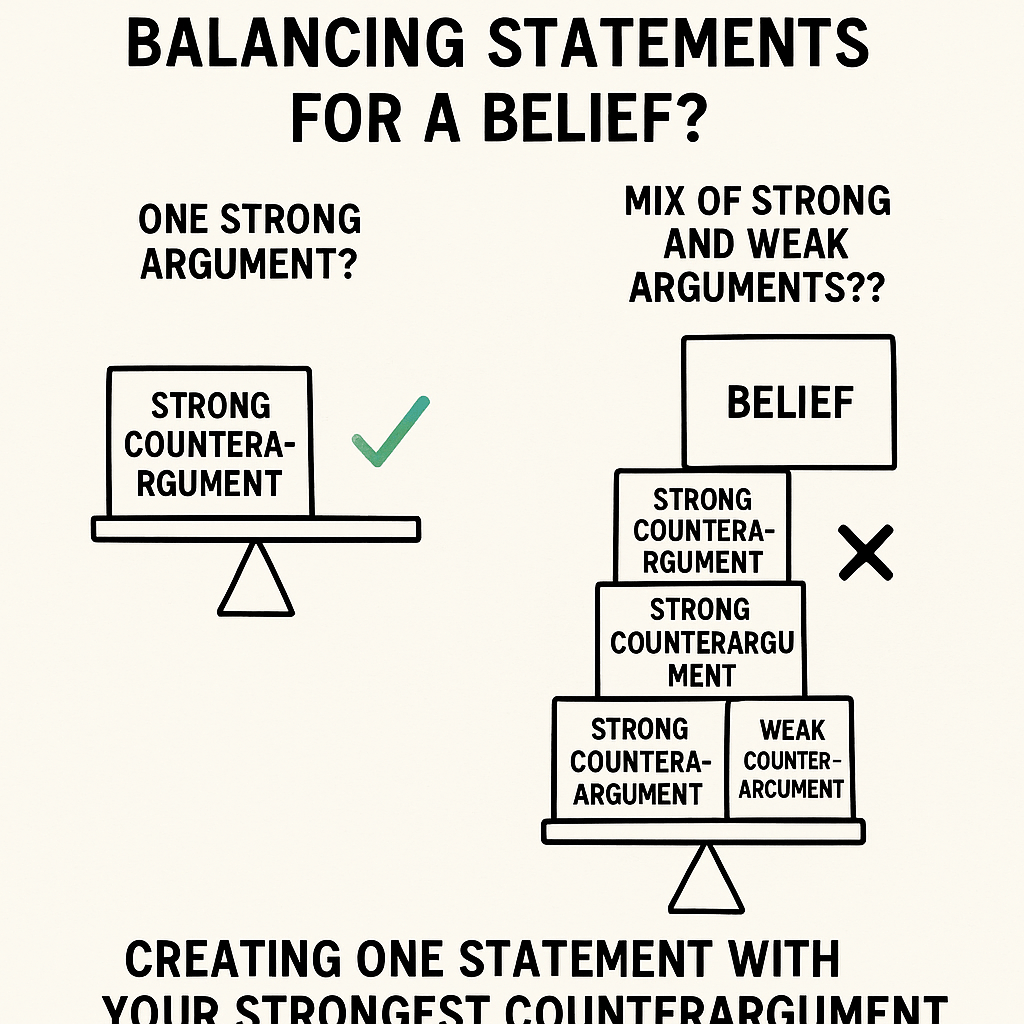
The answer: you can prepare several, but each one should stand on its own, built around a single strongest argument.
Why You Should Focus on One Strong Argument per Statement

Psychological research into persuasion shows that one strong argument (let’s call it argument A) is usually more effective than a list of argument A plus several weaker ones (B, C, etc.).

Although it might feel intuitive to pile on supporting reasons, studies show that this often dilutes the impact of the strongest point — a phenomenon known as the dilution effect.

In practice:

Adding weak arguments reduces the perceived strength of the strong one — people unconsciously “average out” the strength of the message.

So, instead of reinforcing your case, you might unintentionally weaken it.

How to Use This in Creating Balancing Thoughts

When challenging a belief, your goal is not to overwhelm it with quantity, but to pierce it with quality. That means:

✅ Do:

  • Write one clear and compelling balancing statement based on your most powerful counterargument.
  • If you discover other completely different strong arguments, create separate statements for each.

❌ Avoid:

  • Mixing in weaker or redundant arguments just to “say more.”
  • Turning a strong statement into a diluted list.

Example

Limiting belief: “I can’t succeed because I’m too disorganized.”

Weak version:

“I’ve had some moments of being organized, and my friends say I’m smart, and I once made a to-do list that helped.”

This tries to do too much — and ends up sounding unconvincing.

Strong version:

“I’ve successfully completed big projects at work by using a simple weekly planning system — so I know I can function productively when I follow that process.”

One clear, powerful fact. It hits harder.

What If You Have Multiple Strong Points?

Perfect. Then write multiple separate balancing statements — each one with its own “A-level” reasoning. Keep them focused and strong.

Remember: you’re building tools to shift your beliefs, not writing an essay. Each tool should be sharp and specific.

The Process

  1. List all arguments and evidence related to the belief.
  2. Identify the strongest ones — those that really speak to you.
  3. Craft one clear balancing statement for each top argument.
  4. Use them as needed, depending on context and what resonates most in the moment.

Summary

  • You can write several balancing statements for one belief — but each should center on only one powerful argument.
  • Never combine strong and weak points in the same statement — it weakens the overall impact.
  • Your mind responds better to clarity and strength than to clutter and quantity.

Quality over quantity — always.
How to Jump Over the Wall of Resistance and Start Taking Action with Ease 🧱

Have you ever felt this? You’ve got a goal, even some motivation—but when the moment comes to start, something invisible holds you back. You want to act, but instead, you end up procrastinating, getting distracted, or overthinking.

That’s not laziness—it’s something deeper. It’s called accumulated resistance. It’s that uncomfortable mental weight that builds up right before you take action. A mix of discomfort, excuses, tension, and inner pressure.

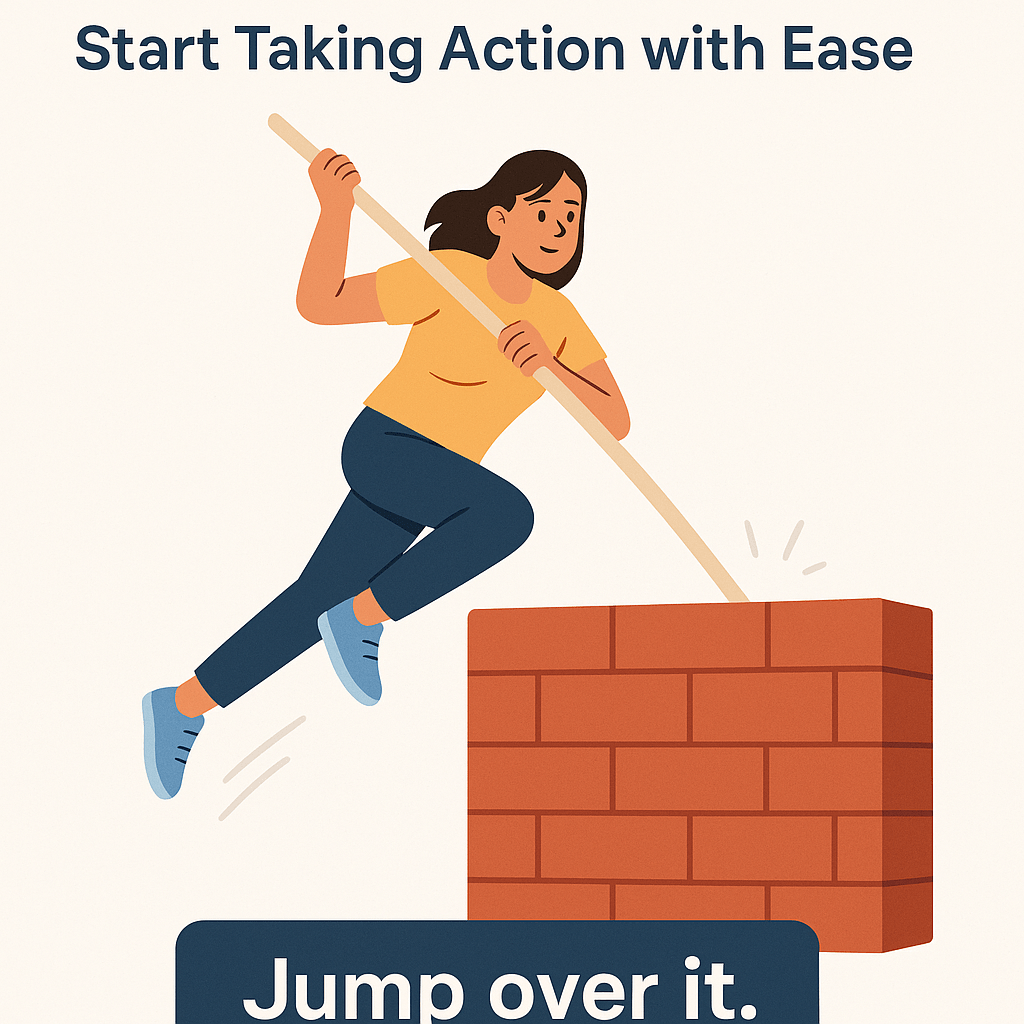
It feels like hitting a brick wall that separates intention from action. 🧱 And if you try to break through it by force, you’ll just drain your mental energy before you’ve even started.

What Builds Up This Wall of Resistance?

  • Doubts like “What if I fail?” or “What if I’m not ready?”
  • Fear of criticism, failure—or even success
  • Low physical or mental energy
  • The temptation to do something easier or more enjoyable
  • Perfectionism or overwhelm 🙈

Most of the time, this all happens right before you start. But here’s the key: that resistance drops significantly or disappears altogether once you begin.

So What Can You Do?

Don’t fight it. Don’t waste your energy smashing through that wall. Instead, jump over it. 🦘

Imagine using a long pole to vault over the wall—quickly and effortlessly. That pole is called the starting block. 🏁

What’s a Starting Block?

It’s a tiny, specific, repeatable action that shifts you into motion. It creates tunnel focus—you stop thinking about the whole task and concentrate on one small, frictionless move. 🎯

Examples:

  • 🧽 Cleaning → putting on rubber gloves
  • 💻 Laptop work → closing irrelevant tabs and opening the ones you need
  • 📚 Studying → opening your book to the right page
  • 🏋️‍♀️ Working out → putting on gym clothes

But Motivation Still Isn’t Action… 🔗 So Let’s Add the linked techniques

Even if you feel ready and have your starting block defined, you still need to make a micro-decision that turns motivation into motion. That’s where the linking technique comes in.

There are two simple versions of this technique:

1. The 5-Second Now Formula ⏱️

Use this when you can start right now.

Say to yourself, either out loud or in your mind:

“I’m going to [insert your starting block] right now.”

Then start counting backward:

“5… 4… 3… 2… 1…”

👉 You must physically begin during the countdown. Get up. Move. Do it.
If you don’t, you’ll feel a small sense of discomfort—because you just broke your word to yourself. That’s the emotional cue that builds self-discipline.

📌 Example:
You’re sitting on the couch watching Netflix, but your starting block is “sit at the desk and open my book.”
Say: “I’m going to sit at the desk and open my book. 5… 4… 3…” — start moving.

2. The Future Link Formula 🔮

Use this when you can’t start right now, but you know when you will.

Say:

“As soon as I [trigger event], I’ll [starting block].”

📌 Example:
“As soon as I get home from work, I’ll sit at my desk and open my book.”

No countdown here—just a clear mental contract for a future trigger. 🎯

Why Does This Work So Well? ⚙️

Because it links intention to action in a specific, timed, and non-negotiable way.
You’re not waiting for motivation—you’re giving your brain clear instructions and a deadline.

Used alone, it helps.
Used together with the starting block, it’s magic. ✨

In Summary 📝

  1. Resistance is real—but it drops after you start.
  2. Use a starting block to trick your brain into effortless tunnel focus.
  3. Use the linking technique to go from “I want to” to “I’m doing it.”
  4. Combine both to leap over resistance like a pro.

You don’t need to force your way through the wall.
Just jump over it.

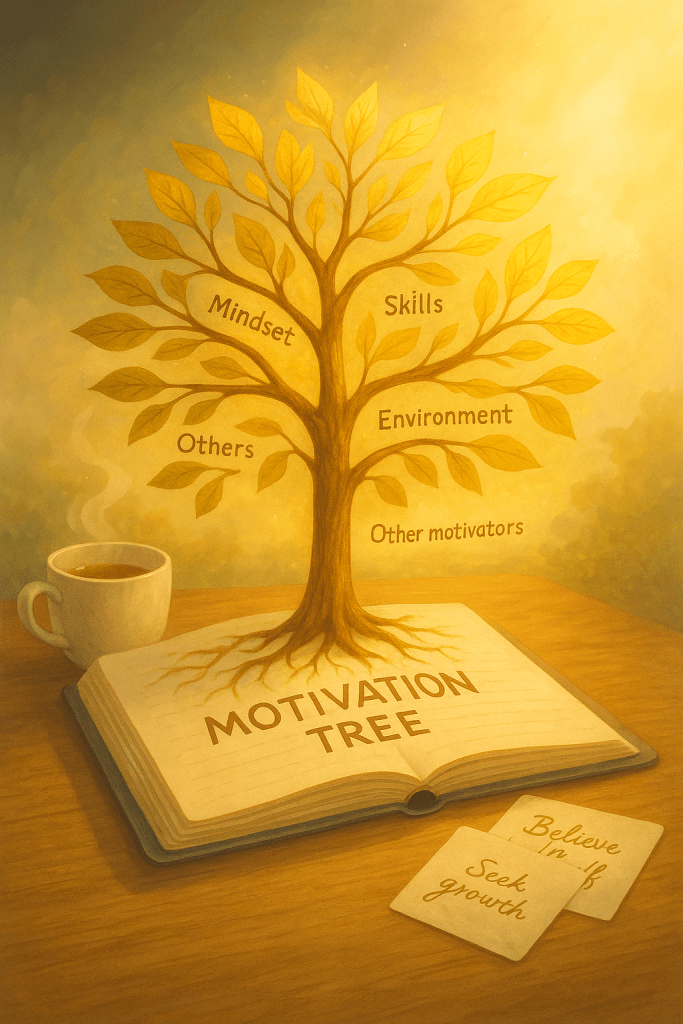
How to Find Your Deep Motivator? Step by Step with the Motivation Tree

Why do we pursue some goals easily, while others we abandon after just a few days? The answer often lies in motivation—but not the superficial, fleeting, or external kind. It’s about deep motivators that align with our values, beliefs, and needs. Only they have the power to build lasting, internal motivation.

1. First Step: Recognize Your Inner Motivation

Before you start building habits, ask yourself: Why do I even want to do this?
It’s not a cliché—this is the first and most important step toward change.
Example? I want to learn Swedish. But if I don’t want to give up after a week, I need to find real reasons that drive me—my personal benefits, not someone else’s expectations or generic templates.

2. Choose the Activity You Want to Build Motivation For

For me, it’s learning Swedish regularly. In an app (or on paper, in a notebook, wherever I want), I create my own “motivation tree” – a place where I will write down step by step what this activity gives me in various areas of my life.

3. The Contexts in the Motivation Tree – Where to Look for Benefits?

The motivation tree is about one question:
“What does this give me?” Why do I really want to do this?
Here are the contexts that help uncover what’s often hidden:

a) Mindset (Psychika)

How will this activity affect my emotions, self-confidence, sense of worth?
👉 For example: greater confidence during conversations, inner calm, sense of effectiveness, pride, independence.

b) Skills & Competencies

What skills will I gain?
👉 Advanced knowledge of Swedish, better communication at work and in personal life, improved memory, focus, and creativity.

c) Environment & System

Impact on my surroundings, workplace, the world.
d) Others

How will this affect the people around me?
👉 I could understand my loved one. I will inspire my loved ones to learn other languages, become a support and authority figure for someone.

e) Spirituality

Does this activity bring me closer to something greater—my mission, purpose, inner fulfillment?
👉 At first, it was hard to see. But then I realized that striving to become the best version of myself, fulfilling my potential, truly moves me.

f) Other Motivators (social, material, prestige-related)

What else will I gain?
👉 Understanding Swedish media, politics and humor, more opportunities to meet interesting people abroad.

4. You Don’t Have to Fill It All – You’re Looking for Clues

This is not about completing every box in your tree.
Sometimes, just a few strongest motivators—those that really move you—are enough.
A motivator can fit more than one context, and that’s totally fine.
It’s not about perfection. It’s about truth—digging deep to uncover what genuinely drives you.

5. Goal: Find the Deep Motivator You Control—Not Others

This motivator—personal, internal, strong—will be the fuel that keeps you going regardless of outside conditions.
It’s not a “stick,” not a “carrot”—it’s your inner why. And it’s always with you.

Your Turn

🔸 Choose one activity you want to build stronger motivation for.
🔸 Fill out the motivation tree based on the steps above—be honest with yourself, do it in silence and calm, just for you. You’re answering why you truly want to start, change, or stop doing something.
🔸 Pay attention to what shows up in different contexts—those might be the clues to your deep motivator. And that’s exactly what you need for this activity to become a part of who you are, not something you do out of obligation or fear of loss.

The goal is to shift from “I must” to:
👉 “I want to.”
👉 “This is who I am.”
👉 “This activity is part of me.” 💛

In the next part, we’ll dive deeper into your motivator(s).
But for now—just start exploring.

Good luck! Marlena 💛💛💛