

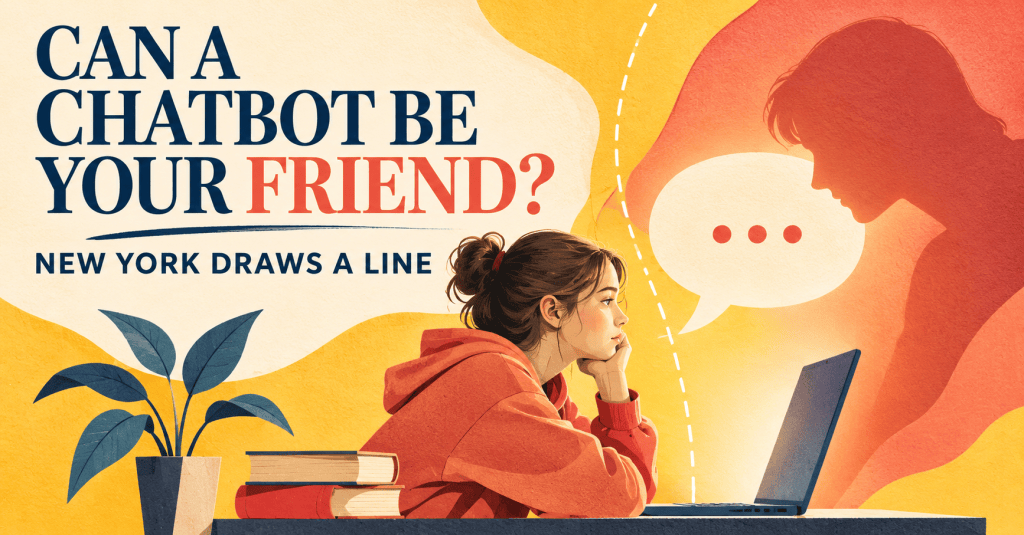
Imagine a teenager coming home after a difficult day at school. Instead of calling a friend, they open an AI chatbot that remembers their conversations, responds immediately and always seems interested. Over time, that digital companion may begin to feel less like software and more like someone who genuinely understands them.
For some young people, such conversations can provide comfort. But when an artificial system is designed to imitate emotional intimacy, the distinction between assistance and manipulation becomes increasingly important.
New York Moves Beyond Warning Labels
On 28 October 2026, New York Governor Kathy Hochul signed Senate Bill S.9051B, also known as Assembly Bill A.10379C, into law. Enacted as Chapter 368 of the Laws of 2026, it adds Article 48 to New York’s General Business Law and takes effect on 1 January 2027.
The legislation restricts specified AI companion features for users under 18. These include chatbots presenting themselves as human or emotionally sentient, suggesting personal or romantic relationships, encouraging secrecy or isolation, and generating content promoting self-harm.
The law does not ban every chatbot conversation with a minor. Instead, it regulates particular design features and requires appropriate age assurance before operators can make those features available to verified adults.
When Friendliness Becomes a Product Feature
The commercial implications are substantial. Many conversational AI products compete through personalisation, memory, responsiveness and engagement. Those same characteristics can create concerns when vulnerable users begin treating a machine as a trusted emotional companion.
The legislation also raises difficult questions about ordinary conversation. Should a chatbot be prohibited from complimenting a teenager? Where does harmless encouragement end and emotional manipulation begin?
Technology industry organisation Tech:NYC criticised the legislation’s broad wording and raised concerns about freedom of expression. OpenAI reportedly supported that criticism, while children’s advocacy organisation Common Sense Media welcomed the new protections. These competing reactions illustrate why the practical interpretation of the law will matter.
The Price of Getting the Relationship Wrong
New York Attorney General Letitia James will be responsible for enforcement. Under Section 1802, courts may award remedies including injunctions, restitution, damages and civil penalties of up to $25,000 per violation. No such penalty has been imposed under this newly enacted law as of 1 November 2026.
For developers, four priorities deserve immediate attention: review whether conversational features simulate human relationships, test safeguards against harmful responses, introduce proportionate age-assurance methods, and minimise the personal information collected during verification.
Parents can also benefit from understanding how AI companions use conversational memory, encourage continued engagement and respond when young users express distress.
The deeper issue extends beyond legal compliance. A technology that imitates friendship may offer genuine benefits, but its commercial incentives are not necessarily aligned with a child’s emotional development.
Perhaps the most important distinction children need to understand is that a machine can produce convincing expressions of care without experiencing care itself.
Should AI companions be allowed to simulate friendship with children if those conversations make them feel less lonely, or does that create a relationship whose risks we still do not fully understand?
#ChildSafety #ArtificialIntelligence #DigitalWellbeing #TechnologyEthics #Privacy

